To Contact Us
to page back through Previous Editions click here Index is in right hand column
September 2010 Edition ----
At the start of the month the news is with South Canterbury Finance. We cite here its connection with the former Feltex Carpets Ltd whoes fate we tend to focus on these days. Below is Feltex's top 10 shareholders soon after the IPO. Seventeen or so of these entities are masking companies, many of which seem to be associated with the lead brokers. Forbar is likely to imply Forsyth Barr connections while First New Zealand Capital is spelt out for a few. Of the remainder the Accident Compensation Corporation had about $9m of workers levies to donate to the cause. Forsyth Barr's chief executive chaired the ACC's investment committee at the time. And South Canterbury came in with almost a $5m contribution. Some sort of South Island comradity between Hubbard and Edgar might have been involved there with the two perhaps perhaps sharing the mantle of richest SIer following the death of Howard Paterson one year earlier. If South Canterbury had $1b in this was a throw-away of just one half of a per cent. But it was perhaps the start of the running off the rails.
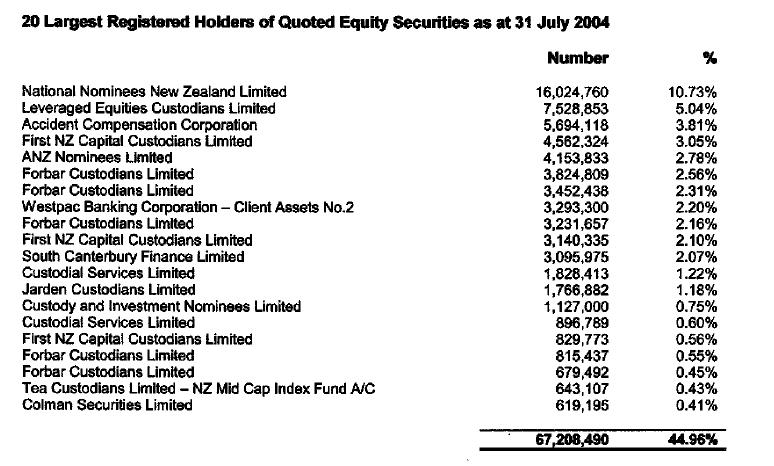
In this edition we call on the Didciplinary Tribunal of the Institute of Chartered Accountants to release its decision concerning Gordon Fulton and his failure to report that Feltex Carpet's bank loans were non current and in breach of banking covenants as at 31 Dec 2005. All decisions should be made and released promptly. Just because he is a partner of a major accounting firm is no reason for a decision being delayed. It might also like to explain why the hearing of charges against Mr Fulton was held in Wellinton when he lives and works in Auckland which is the regular hearing venue in respect to members who live up that way. Half the tribunal live up there as well. Also why was the hearing allowed to held at the same time as the hearing of the trial of the "feltex five" directors? To give an excuse for news media not to be present, we suspect, so different stories could be presented at each venue. The major news media people should have been directly advised of the hearing. The Dominion Post says that it was not so informed. Well maybe but we believe that they well knew about it anyway. They attended the early days of the Feltex Five trial in April. Mr Fulton tried to get an exemption for giving certain evidence saying clearly that he was being brought before the ICANZ on related matters on 29 June. Those reporters are not deaf. The News Media are involved in a coverup of the Feltex IPO steal which was done with with an understanding from both major political parties that it would not be genuinely investigated. The reason we say was to "get" the country some top medal at the 2004 Olympic Games by cheating. Both political parties are fanatic about getting such medals. The Securities Commission and its retained "expert" Kevin Simpkins duly obliged, the Commission holding a hearing without advising the public. The prospectus asssumed 1% p,a. growth in Feltex's market share from 2003 to 2005 despite it suffering 5% losses in share for the previous two annual intervals. Such losses could be expected to continue because of reducing teriffs, and probably increased competition from Shaws, who Feltex had bought its Australian plants from. Mr Simpkins has implied that was OK and also implied that he did not investigate the claim that the market size was growing at more than 1% over the the previous 10 years and "assumed" that the 2003 size would grow by 1% p.a. over the next 2 years. The trend of the previous 10 years of figures actually predicted that the 2005 size would be 3% below the 2003 size.
The ICANZ tribunal seems bent on assisting the Government with this coverup. It heard how Mr Fulton knew that Feltex was a high risk company which had not met its 2005 projections by a mile. But he "did not have an inkling" that Feltex might have to accept that its loans were on short term notice and in breach of covenants especially if it was to get an extra loan from the ANZ. He somehow "thought" Feltex would be calling the shots at the October 2005 renegotiations, so much so that he was not curious enough to check what the new agreement said.
And why should a struggling company such as Feltex be the first to convert to IFRS. We say it provides plenty of excuses for claining that cooking the books was accidental.
We say the Feltex Five and Mr Fulton are being put through some pretend ropes to make it look as if the authorities are doing all the can to punish any Feltex culprits.
We object to one Peter Garty being appointed Interim Chief Financial Officer of Wellington City Council and comment more directly on the Auckland District Court case Ministry of Economic Development v Feeney and others having read that judgement. We also wish to ridicule the stated savings promotion of the Government when it has been responsible for wrecking investor confidence to save by going along with the $250m Feltex IPO raid of investors and rewarding those in the thick of the swindle.
Well Peter Garty now appears to rank as number two on the Wellington City Council staff list after the CEO Gary Poole. In 1990 he was the Ernst and Young Audit partner who issued an unqualified audit report with respect to the Bank of New Zealand annual accounts knowing full well that the profit was overstated by close to $100m. At that stage the bank was largely Government owned. He was aided and abetted in this deceitful act by one Elizabeth Hickey, Ernst and Young's Senior Technical Officer at the time. Central to the case were two large ($200m) parcells of long term zero coupon bonds (assets) purchased by the Bank in March 1988. By 1990 it had been well established that the Yield to Matuity method was the only acceptable method to allocate earnings (or costs) of such bonds between accounting periods. The BNZ had set up arrangements whereby the 1990 year would receive some $70m more income than YTM would allow, so increasing its profit by that amount. The audit notes purport to show that Ms Hickey declared about half the excess income for one parcel of bonds and then posted it to an unders and overs schedule. She purported to decide that YTM could not be applied to the other parcel because it was subject to a variale interest rate so the "straight line" method used was "accepted". In fact the bond was not subject to a variable interest rate but even if it had been that would be no excuse to accept the straight line method. The same problems would exist if one tried to do the straight line method with a variable interest rate. Mr Garty invented a whole host of items of profit understatement to offset the $27m overstatement which they had "detected", none of which had validity. After the audit report was issued he told the bank that they were "possible" items of profit understaement. Also after issueing the audit report he purported to somehow became aware that that the bonds that they "thought" had a variable interest rate did not do so but he nevertheless "thought" that these bond were a borrowing and not an investment and hence the excess profit on them he "thought" was an excess loss which in his imaginary scenario neatly offset the excess profit produced by the imprpper treatment of the other parcel of bonds.
The details are all to be found at http://www.sec-com.govt.nz/downloads/report-of-enquiry-into-certain-arrangements-entered-into-by-bnz-march-1988.pdf In more recent times Mr Garty was at the centre of a bizarre incident involving the conveying of market infomation. Mr Garty had a senior job at Telecom and a friend who worked in the Cabinet (Govetrnment minister's) office. The government decided to take action that was to the detriment of Telecom. When it was still secret the friend took a copy of the document to "show" Mr Garty who in turn took it to his work to see what his workmates thought of it. In this way the matter became public. We believe this is another case of him improperly working with the Government to give it what it wanted.
We say there is no suitable place for Mr Garty in the field of commerce and his employment at the WCC suggests that they want him to help hide some sort of trouble they hsve got into.
Well that brings us back to the Court case of Ministry of Economic Development v Feeney and others. This is what the five directors of feltex are said to have done.
Engaged a highly reputable accounting firm (Ernst and Young)to prepare an IFRS assessment report identifying key areas issues that needed to be addressed in the transition 31Well it was the job of the MED to lambast that "highly reputable" claim but it does not appear to have done so. We have covered the $100m 1990 BNZ reported profit jack-up which Ernst and Young oversaw. There was no reputability to be earned in that. Next we should mention the report Ernst and Young prepared for the shareholders of Tui Milk Products in 1996 just before these shareholders were about to vote (for a second time) on whether the company should merge with Kiwi Co-operative Dairies. Ian Silver and David Cullwick were the highly disreputable accountants involved on this occasion. John Hagen, one of the five acquitted Feltex directors knows about this case. He was appointed an expert witness when certain of the Tui shareholders took the companies to the High Court over the way this merger proposal was presented. We just about said that Mr Hagen represented the defendents but as an expert witness he was their to impartially assist the court and that precludes any representing. We have the judgement of this case on site.
The most controversial matter was a "differential" of some 60c per kilogram of annual milk solids supplied to be paid (once only) by the shareholder/suppliers of Tui.The most telling sentence of the judgement was the last sentence of paragraph 226 which reads "He [Mr Hagen] said that EY's analysis showed that, without the differential, the Tui shareholders were projected to be approximately 141 c per kilogram of milk ahead of their stand-alone position and even after the differential, approximately 90c ahead.
This is a very rough sentence. The question is what is meant by the expression "kilogram of milk". It is not spelt out in the judgement. The purpose of the "quote" was to give readers of the judgement evidence that Tui shareholders stood to do very well from the merger and it would be foolish of them to turn it down because of the differential being charged. We claim that as an expert officer of the court Mr Hagen would have had full responsibility for that sentence being contained in the judgement. We believe a reader of the judgement is entitle to infer that after the merger Tui shareholder stood to get 90 cents for each kilogram of milk (ie one litre bottle full) supplied to the merged company then they would get from Tui if the merger did not go ahead. Well it is clear from the Ernst and young report the 90 cents referred to milk solids (about a tenth of the milk by weight ) and not the milk itself. So the Tui shareholders were not fooled on that score, only some casual readers of the judgement. But we say that informed public scrutiny is important. It is we say true that EY's report said that Tui shareholders were projected to be approximately 90c per kilogram of milk solids ahead of their stand-alone position with the differential applying. Is that correct? We say not. It depends what one infers by the expression "kilogram of milk solids". We say the inference is all milk solids supplied by the shareholder after the merger or after the time when the proposed merger would have taken place. We believe that that is what some of the shareholders about to vote (for the second time) thought, or thought was possibly the case. And based on a plain English interpretation of what the EY report said the Tui shareholders were perfectly entitled to think that But EY claim that what they really said was that if the shareholders continue to supply the same quantity of milk for the next 20 years the extra payments they will receive from the merger will be the equivalent of receiving 90 cents for each kilogram of the annual supply of milk solids as a once only payment paid up front (there and then).
While the literal interpretation of what EY said would generally have been seen as being too good to be true by Tui shareholders we say it will have caused many shareholders to vote for the merger because the cost of voting for the merger, even although they may not have liked the idea of it, was very low whereas benefits if EY was literally correct, was very high. All shareholders who were involved in discussion of the issue knew that the 90cents was a notional immediate payment per kilogram of annual milk solids supplied which represented the benefits to be received over time, and not an extra payment to be received for each kilogram of milk solids to be supplied from then on. By we say that not all shareholders would involve themselves in such discussions and would have cast their vote in the light of the written material supplied. The EY report said the benefit was 90 cents per kg, milk solids for the years 1996 to 2015. This is fully consistent with it being the extra payment to be included in the payment for all milk solids supplied following the merger. Why would certain shareholders choose not to question it? Well firstly they might not want to offend one of the factions by giving an indication as to how they are going to vote. Secondly, if, as they suspected, the 90 cents did not pertain to all milk solids supplied from then on, they were liable to get the rejoinder "you didn't think that did you? or be thought of as being a bit thick without it being communicated. Thirdly they would expect the EY report to explain itself in unambiguous everyday language and not in some version of dairy farmer speak. Fourthly many would have confidence in their ability to comprehend professionally written material and wished to project an image that this was so. Asking questions compromises such a stance. Fifthly many shareholders would wish not to waste time over the issue and just read the official reports and vote according to impressions gained. In all these five cases such shareholders were not going to lose any possibility of an extra 90cents on all milk solids supplied henceforth because they had failed to believe in it.
Ernst and Young with the aid of the pro merger lobby had couched their report in order to mislead. Apart from how they express it the calculations themselves were not right. The big problem with NPV is selecting an interest rate. In this case 11% was selected because that was what many farmers were paying. This was probably far too high as a long term real interest rate, and gave a low NPV benefit. A low benefit made it more credible that it was an annual benefit but did not impress the majority who knew for sure that it was not. So EY made a "mistake" to increase the NPV benefit to what they thought was optimum. That is why they are highly irreputable.
Then we have the case of Fergus Dick, the EY auditor of the meat company PPCS. This company held shares in Richmond Meats but did not wish this to be known to Richmond and others. So PPCS had the shares held in a trust as is normal but a problem was it had to give a guarantee to the bank who had funded the purchase. Any sizeable guarantees have to be declared in ones annual accounts as is understandable. But this is no problem when you have reputable accountants like EY and Mr Dick as auditor. He allowed PPCS to report "Bank Guarantees - Nil" for three or four years in a row when this was not so. Along the way the bank decided that the guarantee was not adequate and this resulted in more board resolutions which Mr Dick did not notice.
But closer to home was the Feltex IPO. The Auckland District Court, hearing the case against the five Feltex directors was told by Mr Nichol of McGrath Nichol how the ANZ bank had concern for its loan to Feltex in 2002. This was only alleviated when Feltex got a loan which was to be repaid out of the proceeds of a public share issue. So the company was virtually worthless but nevertheless was able to raise $250m which it priced itself at. Ernst and Young were auditors for the IPO. They were not required to vouch that the company was worth that, that is what potential investors have to decide, but the price was so far out of kilter with its value that we say any reputable auditor would have nothing to do with that IPO. In the last sizeable paragraph of the auditors report in the IPO they say the only reason they do give there opinion on whether the projected 2005 results will be achieved is a reason which is applicable to all projected results, ie there is no absolute certainty about the future. We say they knew plenty of reasons why Feltex might collapse. Four of these Feltex directors would be well aware of this.
This judgement does not appear to discuss the IPO. It would be argued that that was not what the charges related to. But if comments are going to be made about the honesty and integrity of the accused directors and the auditors then a wider perspective needs to be taken.
So Ernst and Young are not reputable. The other reason the Feltex directors should not have consulted them is because they are Feltex's auditors. They might not have been auditing the six month accounts concerned but they were reviewing them, which we think is a watered down version of an audit. Anyway they were going to be auditing the annual accounts so the six monthly ones were their business . The directors are not entitled to get assurance from the auditors. The auditors are there to give independent assurance to outside parties. EY make this point in paragraph 188 of the report of the securities commission but the court does not seen to pick up on it. The directors must get their assurance from elsewhere. Ernst and Young should not have been auditing their own work or their own advice and the Feltex directors should have well known this. Indeed it is quite obvious that there was no independence being exercised by either party. The idea of EY doing a review of the six monthly accounts was EY's according to the evidence, A nice little income earner that did nothing. It had nothing to do with those "ever vigilant" directors. Ernst and Young allowed the Feltex IPO to go through to keep in thick with government interests. The directors did not want the public to know that that it was in breach of its bank loan covenants and the loans were now classed as current. The bank, we suspect, did not want the public to know that either. So Ernst and Young just continued in their role as facilitator. They had arranged a nice little trick up their sleeve anyway. The work would purportedly be done in Australia but a NZ partner would be accused of any wrong doing if the authorities found such an accusation to be necessary. Ha ha ha.
Paragraph 7 of rs-1 says:
RESPONSIBILITY FOR THE FINANCIAL INFORMATION
7. While the member is responsible for providing a review report on the financial information, the responsibility for the preparation of the financial information and the assertions contained therein, lies with the management of the entity. Management's responsibilities include the maintenance of adequate accounting records and internal controls, the selection and application of appropriate accounting policies, and the safeguarding of the assets of the entity. The review of the financial information does not relieve management of its responsibilities.
We challenge statements made about about GAAP (the previous accounting standards) in paragraps 63cand 64 of the judgement. It is claimed that under GAAP a loan would be determined as being current or non current by being "assessed on the basis of the expectation as to whether the company would be required to repay in the upcoming twelve months". The judgement does not say where this interpretation came from. Well we say the standards were never that rough and indeed it depends upon the legal term of the loan agreement. We do not believe Mr Fulton the EY NZ partner involved with Feltex) at his hearing before the NZICA tribunal mentioned anything of that sort either. According to him the Feltex loan facility had been for a 12 month term or 12 months notice (presumably under both GAAP and IFRS), subject to some financial ratios being maintained, and so was non-current. But in October 2005 this was renegotiated to 1 months notice and so the loans were then current. EY have told the Securities Commission (paragraph 172) that the changes in standards with respect to loan classification were not significant. We rather believe them on that point. However although Mr Fulton recognised Feltex as being a high geared high risk company who's bank had some concern about its loans, he expected Feltex to be the powerhouse when it came to the re-negotiations and he expected that it would get more money that it wanted and would ensure terms of the loan would be changed so that the loans remained non current at the end of that December. Hence he did not bother checking out what the new agreement said. We do not believe him on that point and consequently believe that he should no longer have an auditor's licence.
We say the director knew that the loan term had reduced from 12 month's notice to 1 month's notice in the October 2005 re-negotiations (referred to as the forth restatement). They were the ones who did the re-negotiations. We say that should have (and would have) prompted specific inquiry as to whether this would change the non-current status. We say the director's argument is not credible.
to top of page
Advertising section
We link to: Accounting Page - Comprehensive Accounting Resources and Directory.Internet Web Directory - The internet's fastest growing directory of the best web sites. Fully searchable and updated regularly. We Advertise:
Books
Case studies of ICANZ coverups 2 Ernst and Young report to Dairy Co shareholders
Pokemon
Gifts
Cars
Toys
MP3
Videos
Dolls
Garden tools
Jewelry
------------------------
Structure and Operation of an alternative Accounting Organisation designed to shun dishonesty.
Suitable Objectives
Register of Members
Members Forum - Topical
* open to all meantime:

Plenty of Opinion
Magazine Plans
Need an Accountant?
or Prepared to Change?
Users Forum
* have your say
Ready to Join?Offering some Help?
Knowledge Tests
* being developed
Information Bulletins
Why it is being Proposed
What's Wrong with
the existing
accounting body?
So called BNZ Auditan extensive case study Current Attitudes of Existing Institute
 Visit our Advertising
page from Here